
I don't like cornbread
Passing the plate to Sundays come and gone.

I work at a theater. We’re nearing opening night. My boss’ husband made dinner for the whole cast and creative team the other day. He put his foot in that cornbread.
His cornbread was sweet, cakey, soft, buttery to the touch, melt in your mouth goodness. He made a whole spread of tasty chili with all the fixings. But, baby, he put his foot in that cornbread. I ate with greed and thanked him with a clean plate. When he insisted I take some food home with me, I agreed with tinfoil in my hands. I took two big squares of golden cornbread with his homemade honey butter, and foiled them up with dreams of breakfast the next morning. The only thing is,
I don’t like cornbread.
Every Sunday after church, the cast iron skillet became an extension of Granny’s hand. Cornbread seemed to simply appear in the skillet, hot and ready, whenever she willed it. Cabbage, chicken, sausage, salmon croquettes, greens, string beans, smothered pork chops, oxtail soup. No matter the meal, Granny’s cornbread was there to help you sop it all up!
But none for me. My hands wouldn’t reach for the stuff. Cornbread never agreed with me. I didn’t like the taste. I didn’t like the texture. I didn’t like the way it expanded on my tongue and slowly suffocated me as I pushed it down my throat. I ate everything else in her kitchen with delight. But cornbread? No, baby. None for me. No, thanks.
My childhood happened at a time where Sunday afternoon boredom was a guarantee and it was up to you to fix your attention on something. For me, it was people watching my family. I was the youngest of the bunch by seven years and I was obsessed with how my kin had set up the world in my absence. I watched them laugh through stories. I watched them gossip and enlist the bible as their witness. I watched them act out relationship dynamics that were passed down to them, which I wouldn’t understand until much later in life. Throughout all of this, I witnessed my granny, mother, aunts, and all my cousins swallow yellow mounds of cornbread, seemingly unaffected by the very characteristics that made it undesirable to me.
You can imagine how absolutely absurd it is to feel taunted by cornbread.
How you don’t like cornbread? It’s cornbread.
Or, to my ears: How are you not like the rest of us?
Absurdly silly as it may be, my difference was my devastation. I was lost and ashamed and resentfully unclaimed.
The problem must have been me. It was the cornbread my mother made and all her sisters. It was the cornbread my granny made, and likely her granny before her. I was desperate to prove I was just like them and a part of their world. Somehow, I believed the cornbread was the missing piece to inclusion, understanding, identity, and whatever else I had decided I didn’t have.
I tried to do as I saw.
My fingers pinched yellow crumbs and plopped them into my mouth with a prayer. But it never tasted right. Each textured grain was a reminder that it wasn’t for me. That I didn’t receive what the cornbread gave to my cousins, my aunts, my mother, my granny. I grew to worry it was a warning that I was too different than the rest of them — than anyone, for that matter. If I couldn’t master the fundamentals of Mississippi life like cornbread, then how was I going to pull off any other facet of a normal? Whatever special cornbread genetics that had bonded my family ran out before me and I could only sit and watch.
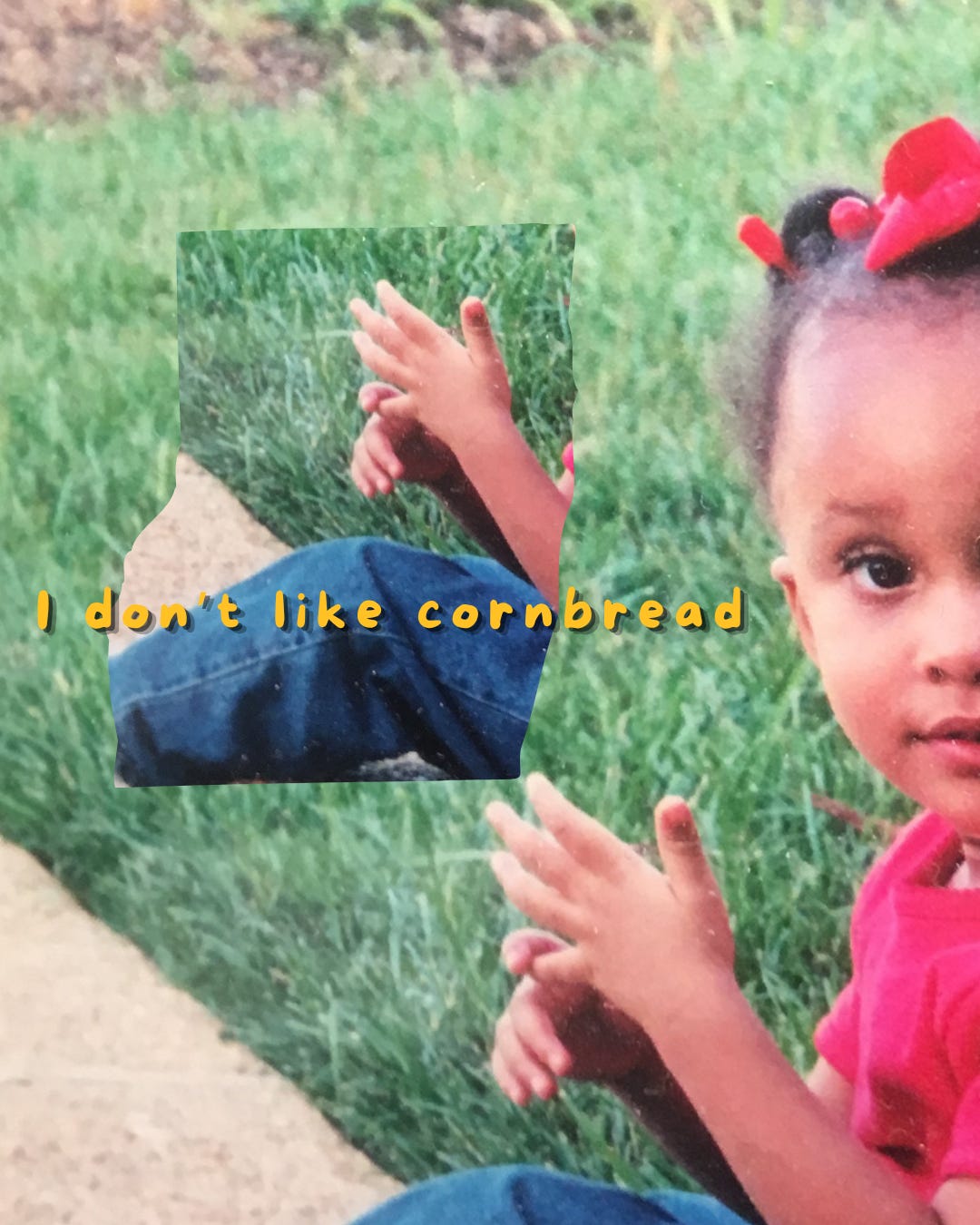
Today, I’ve convinced myself that my hands don’t possess the same cornbread making skills of my family. That perhaps I could even accept or be proud of such a thing, as complicated and ridiculous as it may be.
And then, of course, the phone rings. And I smell the yellow bread in my home and I think, how did this get in here? I don’t make cornbread. In life’s great devastations, when I can’t make sense of my circumstances, I feel the textured grains push down my throat. In conversations that break my heart, I begin to suffocate from habits that never agreed with me. And of course. There her hands are: warm, brown, and lovely, passing me the yellow bread that I swore I would never reach for.
Poor thing. You cannot disown what the blood is made of. The blood is the recipe for life.
Whenever someone or someplace would offer me cornbread, I’d shake my head no. I don’t like cornbread. I wouldn’t miss it on my plate. I was relieved – proud to avoid the stuff others feasted on. I was determined not to suffer. Daring and foolish, all the same.
Then, over the years, here and there, I’d nibble and swallow a bit of cornbread and say, Oh, this cornbread is different. I like this cornbread which is funny because I don’t like cornbread.
And more and more it happened. I met cornbread that was fluffy, and smooth. I tasted bread with sweet flavor that I swallowed with ease. And as I sit here now, eating these golden squares that my boss’ husband made, (he put his foot in that cornbread) I’ve come to appreciate what Granny made for Sunday dinner: each generation’s best efforts passed down to my plate.
The recipe to Granny’s cornbread comes on lined paper yellowed by heat and time with a cursive spell that breaks my heart. But it’s mine and hers and ours. I’ll write my own recipes, anyhow. Then that will be ours too. And somewhere. She will feast. After all, despite everything, there was always love in the skillet.
Yes, it appears I’ve written an entire essay about cornbread. But for me, it was never about cornbread. Not really.
“I was obsessed with how my kin had set up the world in my absence”
Beautiful 🥰